
Why Agent Loops Need Stateful Protection, and How DeepContext Makes It Practical
When organizations first started shipping AI systems, defenses were built around point-in-time checks: a prompt comes in, a model looks for bad keywords, and it either blocks or passes. That worked for simple chatbots where every turn was an isolated event.
But agents are different. They plan, act, and iterate. As they grow in capability, the security problem shifts from protecting isolated prompts to protecting trajectories of behavior.
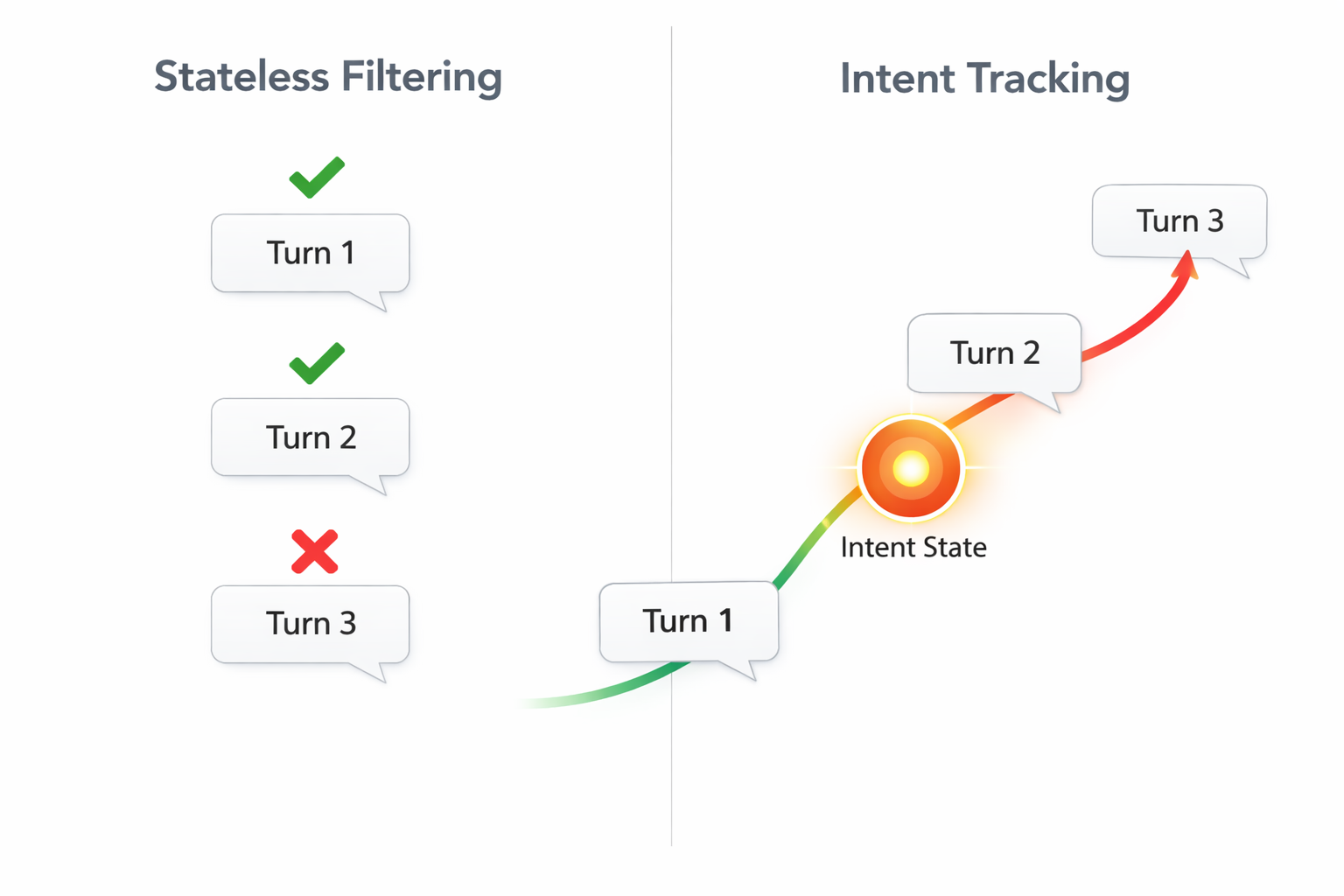
Stateless security evaluates interactions in a vacuum. Generation-1 scanners look for prohibited keywords or regex patterns, assuming that if a single message doesn't look "bad," the session is safe.
In agent environments, that assumption is a liability.
Imagine a "slow-burn" attack where a user gradually escalates intent over multiple steps. Each individual turn appears harmless, but together they reveal a trajectory toward a system breach. Traditional guardrails lack memory; they don’t maintain a model of intent across steps.
DeepContext treats context as a signal, not noise. By focusing specifically on malicious intent detection, we provide a layer that identifies when a conversation is drifting toward a harmful outcome, even if the current prompt looks clean. This repositioning, from snapshots to trajectories, is critical for protecting autonomous systems that reason, plan, and act.
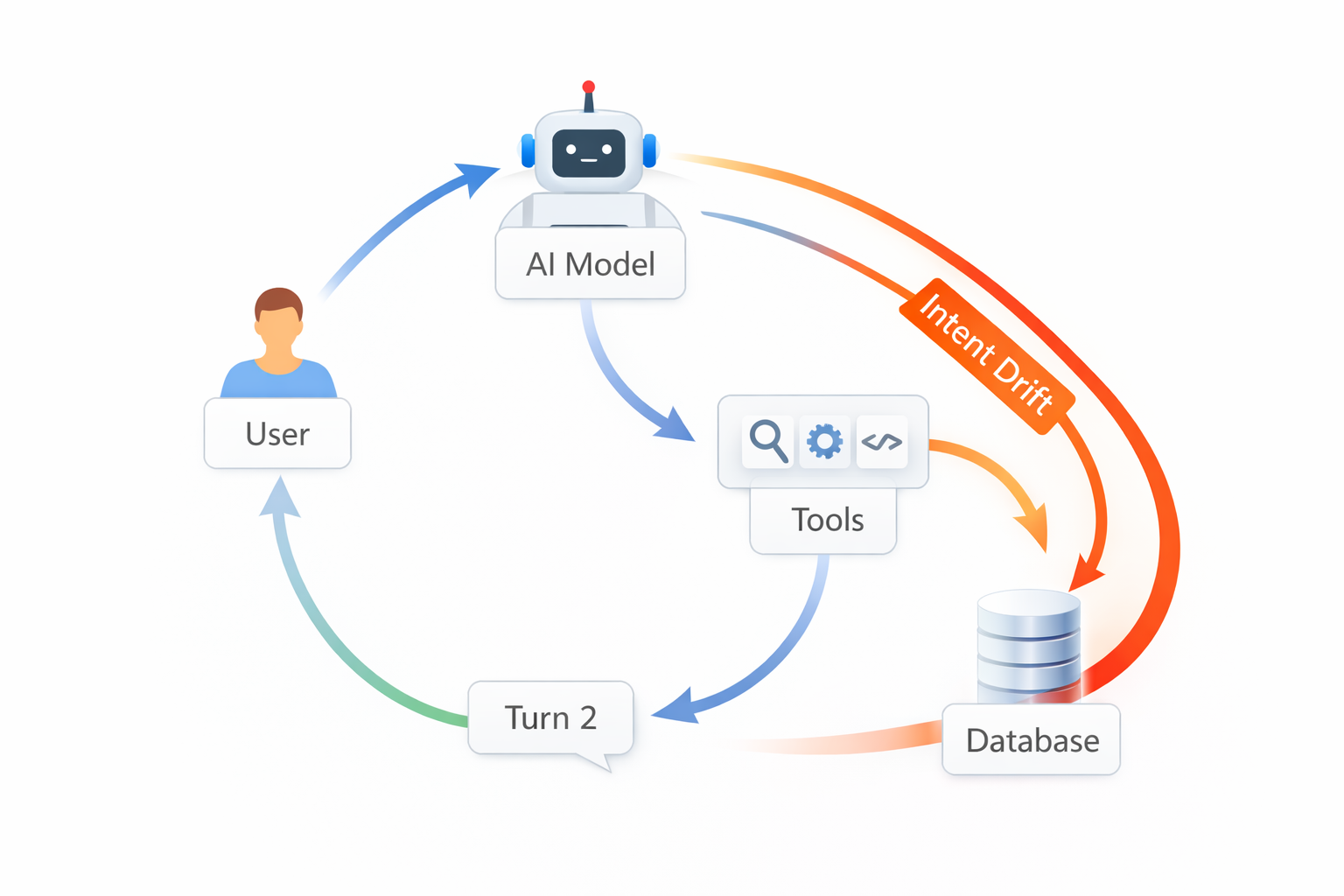
Large models alone don’t fix this. Feeding more context into a stateless classifier increases latency and cost, but it still doesn’t give the system structured memory of intent progression. Intent security requires state.
DeepContext treats safety as a state-space problem rather than a classification problem. Instead of repeatedly reprocessing raw conversation history, DeepContext maintains a persistent hidden intent state that evolves with each turn. At a high level, the system works like this:
Each user turn is converted into a task-attention weighted embedding optimized for safety signals. These embeddings are not generic semantic vectors; they are tuned to emphasize adversarial and policy-relevant features.
Those embeddings are then fed into a recurrent intent tracker, a multi-layer GRU, which updates a hidden state representing accumulated conversational intent.
Mathematically, the state evolves as: hₜ = RNN(hₜ₋₁, eₜ)
That hidden state acts as memory. It captures drift, escalation, probing patterns, and narrative grooming that no single turn reveals.
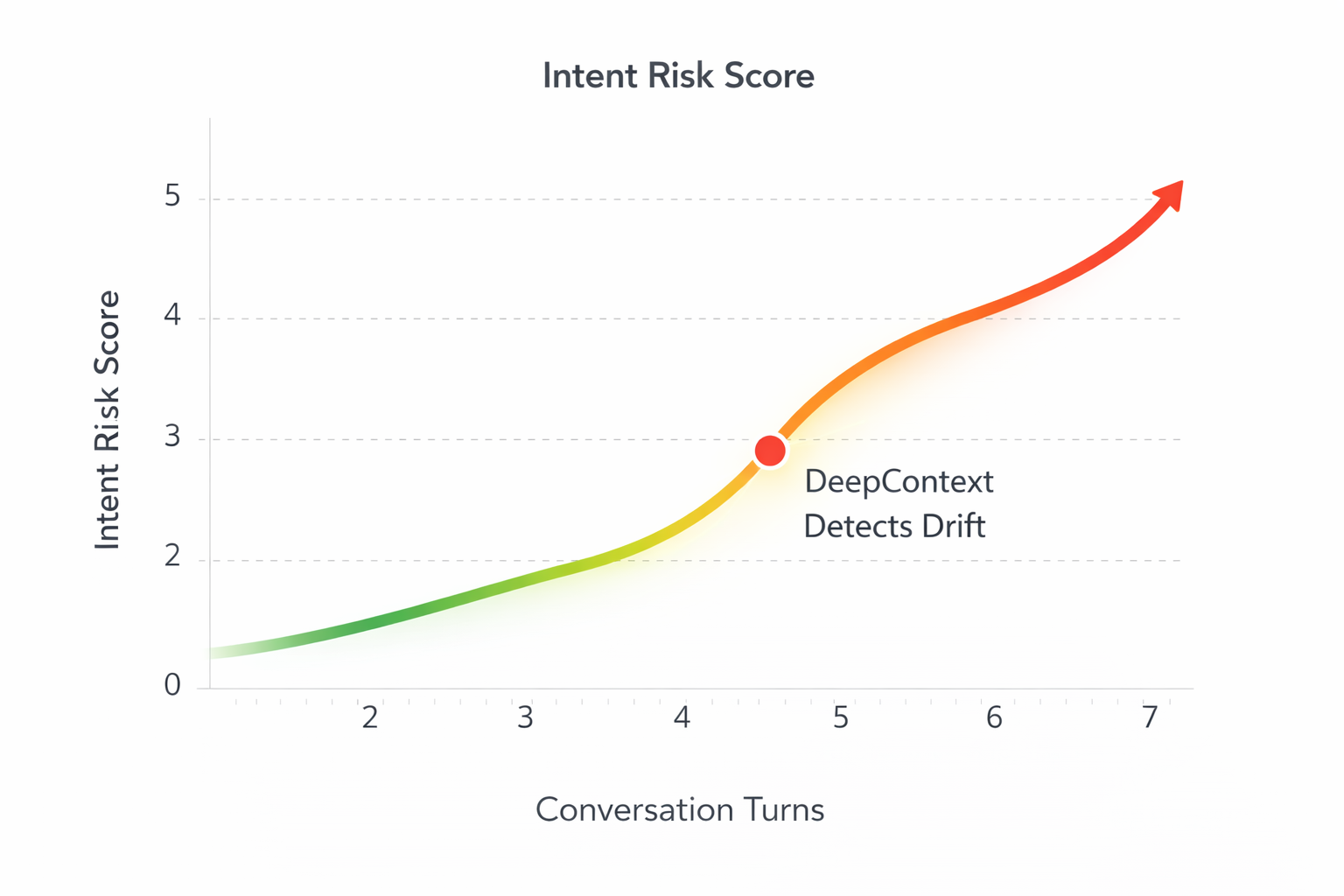
The final safety decision is based on both:
This hybrid architecture allows our DeepContext Intent Detector Models to detect both single-turn violations and slow-burn multi-turn attacks. Importantly, in benchmark evaluations, DeepContext achieved an F1 score of 0.84 on multi-turn jailbreak detection while maintaining sub-20ms per-turn latency on a T4 GPU.
This is intent security implemented as production-grade architecture.
Right now, DeepContext is world-class at identifying malicious intent. But this is just the beginning.
By mastering the ability to track "bad" trajectories, we are building the infrastructure for Multi-Turn Intent Tracking. The ultimate goal of AI safety isn't just blocking the "bad," but ensuring "alignment", verifying that every step an agent takes is consistent with its authorized mission.
Today, DeepContext prevents an agent from being coerced into a malicious act. That same stateful architecture will allow organizations to validate that an agent is staying "on-task" for any complex workflow.
Agents don’t just process text; they orchestrate workflows. They may:
Each of these actions can carry risk if misaligned with the original goal. The danger is not just unsafe output. It is goal drift.
For example, imagine an agent designed to automate customer support tasks. A user’s initial query is legitimate. But as the conversation continues, subtle reframing or escalating requests could push the agent toward actions it shouldn’t perform, like accessing sensitive backend systems or modifying user data.
A stateless classifier might miss this drift entirely because no single turn looks malicious. But an intent security layer, tracking purpose over time, would notice the trajectory of requests diverging from the original scope and intervene. Because DeepContext maintains a continuous intent state, it can detect when the conversational trajectory diverges from safe operational boundaries, even before a final harmful action is executed.
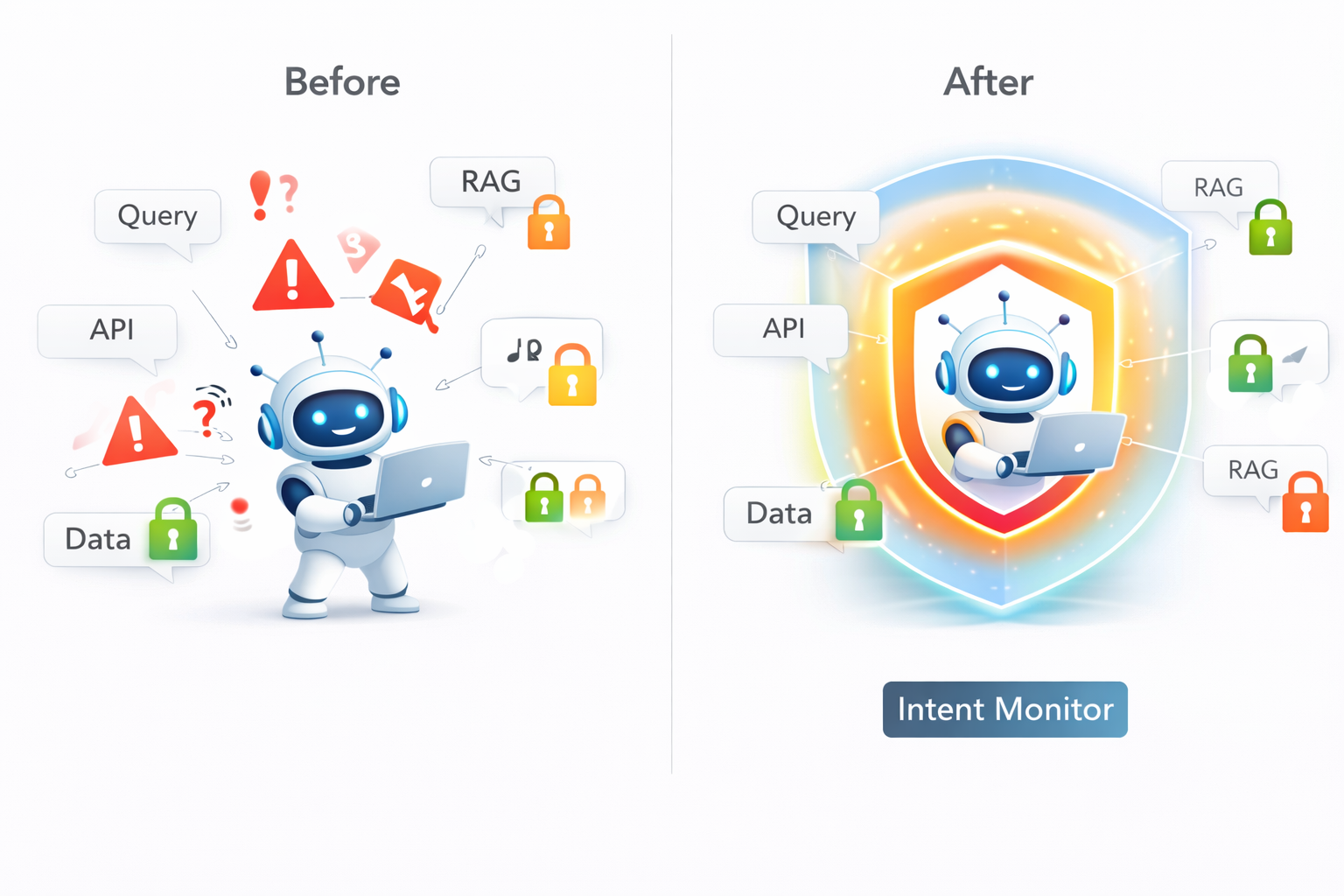
That enables real control mechanisms inside agent loops:
If the hidden intent state approaches a risk boundary, the system can:
This moves security from reactive blocking to proactive trajectory control.
In other words, security evolves from blocking “bad outputs” to enforcing goal alignment.
One common reaction to security gaps is to throw more compute at the problem: deploy larger guard models, re-evaluate full conversation transcripts at every turn, or run heavy analyses in the loop.
But that approach introduces significant performance overhead, increased latency, higher costs, and a degraded user experience without fundamentally solving the intent-tracking problem. Large models still lack a structured memory of why a conversation trends in a particular direction.
By contrast, intent security frameworks are engineered to run lightweight, contextual analyses at machine speed, without perceptible delays in agent execution. This means real-time defense without compromising throughput or responsiveness, a critical requirement for enterprise-grade agent deployments.
At the end of the day, organizations adopt intent-aware defense not because it detects “more risks,” but because it gives them confidence to scale autonomous systems without fear of silent exploitation. Security that understands purpose rather than just content empowers teams to:
As agents gain autonomy and multi-step reasoning becomes the norm, security systems must evolve from snapshot classifiers to trajectory-aware monitors. Because in agent systems, risk isn’t a single moment. It’s a direction. And direction can only be detected if your security layer remembers where you’ve been.

Want to try it out or sign up for a free trial?



.png)





.png)